
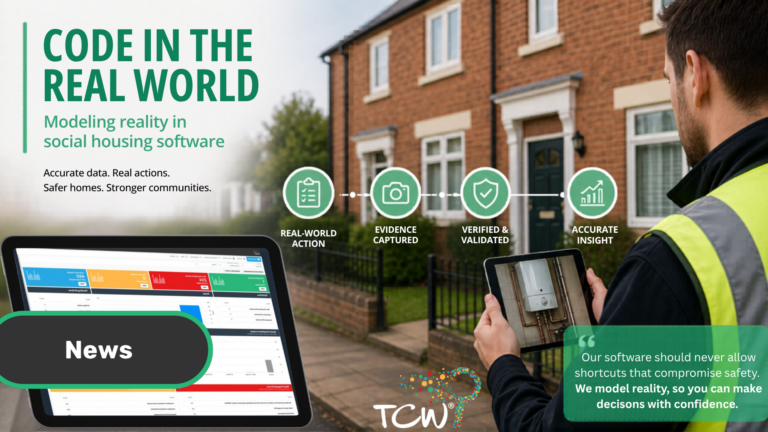
In social housing, the ‘real world’ isn’t just data, it’s a physical entity and a tenant’s home. No matter our role in any software we use, be it Subject Matter Expert or a Software Engineer, it is on all of us to ensure that the technology we build and use to help us run day to day acts as a faithful mirror to the bricks, mortar, and human lives it represents. When software allows a ‘shortcut’, like marking a gas safety check as ‘Compliant’ without a validated certificate upload, or closing a damp and mould case without allowing the resident to self-certify the air quality has improved, we create a dangerous disconnect between our dashboard and the doorstep.
Designing for Physical Truth
Inconsistent representation in social housing software doesn’t just lead to bad data; it leads to process failure. If a system allows a repair to be ‘filed away’ before the operative has physically left the site or uploaded evidence of the work, the chain of assurance breaks. If we shift our thinking to model the technology alongside the physical reality, we ensure that the digital state is a hard truth. This approach forces the software to represent the actions taken in the ‘real world’, as opposed to on our devices.
The Power of Collaborative Design
Achieving this level of accuracy requires more than just technical mapping; it requires collaborative architecture. A solution architect cannot model the ‘real world’ from an ivory tower. We must all work together:
- Frontline Officers: To understand the messy reality of site visits and the ‘workarounds’ they currently use.
- Data Engineers: To ensure the schema can handle the complexity of multi-tenancy and asset hierarchies.
- Residents: To ensure the ‘digital representation’ of their home feels respectful and accurate.
Driving Efficiency Through Authenticity
When multi-disciplinary teams collaborate to model the real world, the ‘friction’ we often try to remove with technology is revealed to be a necessary checkpoint. An inspection that requires a photo isn’t a burden; it’s a verification of safety. A workflow that prevents filing a document away until being approved isn’t a bottleneck; it’s an assurance of quality. Therefore, we should all strive to respect the checkpoints for the vital purpose that they serve.
By designing solutions that refuse to lie about the state of an asset, we create a more efficient, accountable, and safer housing sector. Efficiency is found not in the speed of the click, but in the accuracy of the action.