
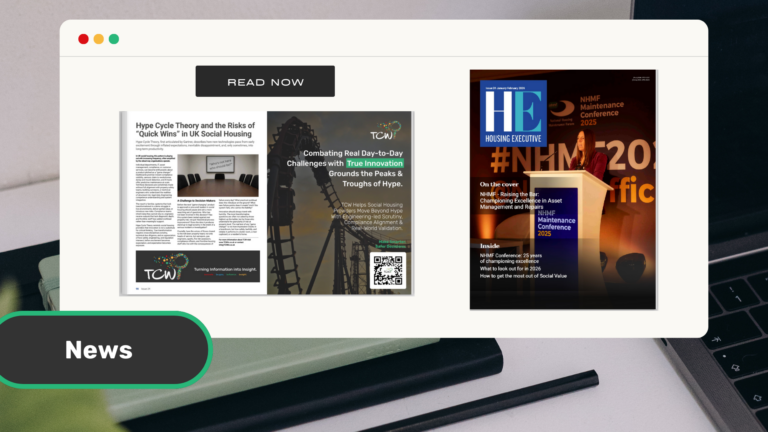
Hype Cycle Theory, first articulated by Gartner, describes how new technologies pass from early excitement through inflated expectations, inevitable disappointment, and, only sometimes, into long-term productivity.
In UK social housing, this pattern is playing out with increasing frequency, often amplified by the siloed way organisations operate.
Individual departments, IT, asset management, compliance, or customer services, can become enthusiastic about a product pitched as a “game changer.” Dashboards promise instant compliance visibility, sensors claim to revolutionise damp and mould detection, and AI tools offer predictive maintenance at scale. Yet these decisions are sometimes made without full alignment with property safety teams, building surveyors, or technical engineers who understand the realities of structural risk, legal duty, Engineering competence understanding and system integration.
The result is familiar, systems that look transformational in a demo struggle in live environments, deliver partial value, or introduce new risks. Compliance teams inherit data they cannot rely on, engineers receive outputs that lack diagnostic depth, and frontline staff face added workload rather than meaningful support.
Hype Cycle Theory reminds social housing providers that innovation is not a substitute for critical thinking. True transformation requires cross-disciplinary scrutiny, technical due diligence, and an appreciation of how safety, engineering, and regulation intersect, before excitement becomes expectation, and expectation becomes exposure.
A Challenge to Decision-Makers
Before the next “game-changing” product is approved or procured, leaders in social housing should pause and ask a more searching set of questions. Who has not been involved in this decision? Has this system been tested against real property risk, not just theoretical process improvement? Does the data it produces stand up to legal scrutiny in the event of a serious incident or investigation?
Crucially, have the voices of those closest to the risk been properly heard, not only heads of service, but surveyors, gas engineers, sparks, fire risk assessors, compliance officers, and frontline housing staff who live with the consequences of failure every day? What practical workload does this introduce on the ground? What new failure points does it create? And if the system fails, who carries the liability?
Innovation should always travel with humility. The most transformative questions are often not asked by those highest up the ladder, but by those who understand the granularity of risk at property level. The real test of any “game changer” is not how impressive it looks in a boardroom, but how safely, lawfully, and reliably it performs in a boiler room, a riser cupboard, or a resident’s home.
Click here to see the full Housing Executive Magazine, Issue 24.