
In print
Software Development in Housing
You enter this journey with the view that it’s going to be hard graft. You’ll have to work long hours and find a way to translate thoughts and ideas into a language that other people can understand. Although that sounds relatively simple, it isn’t.
OCTOBER / NOVEMBER 2026 · 5 min read
In Print
As Featured in Housing Executive.
Issue 29 · October / November 2026 · Page 76

The argument
A Different Challenge Altogether
Take the old children’s game of Chinese whispers. You’d all sit in a circle, whisper a phrase into the ear of the person to your right, and wait to see whether the last person repeated the original phrase. Now imagine trying to explain a genuinely complex idea that requires someone to understand how you want a computer to interpret numbers, phrases and inferences within data, and turn them into an assessment of risk. That’s a different challenge altogether, trust me.
I entered this process knowing and accepting that it was going to be difficult. I knew there would be a lot to work through, but I also knew we’d find a way through the haze and simplify things for the customer. That’s something the team has done extremely well over the last 13 years.
What I didn’t expect was for the complexity of compliance management and reporting to become such an easy sales tool for other software vendors. I didn’t expect systems operating in the same space to assume that compliance meant one thing, build a package around that single interpretation, and then produce marketing collateral suggesting they could do everything.
Compliance Is a Continuous Cycle
Let’s have a brief chat about compliance and what it actually means, because if you don’t understand this, I’m afraid you’ll struggle to operate in this space.
Compliance management is a continuous cycle of responsibility, evidence, risk, intervention and accountability. Every inspection or visit creates information. That information informs decisions, and those decisions lead to actions. Those actions require competent people to evidence completion and demonstrate traceable outcomes. Every stage of that process must remain connected to the next, alongside the wider compliance obligations that follow. If any part of that chain breaks, the organisation loses visibility, control and, ultimately, confidence.
It really shouldn’t be that difficult to understand. Yet, when you look at software vendors promoting compliance modules, or even positioning themselves as compliance management systems, you often see the same thing. They demonstrate a well-presented system for managing information, but show very little understanding of the process that creates it, the decisions that need to follow or the actions required to manage the risk.
Managing Information Is Not Managing Compliance
Managing information about compliance and actually managing compliance are two very different things.
It gets a little harder, believe it or not. One of the biggest frustrations with software development is the time it takes to get things right. You can spend months developing a solution to meet a particular need, only for another need to emerge before you’ve finished. Suddenly, you’re scrambling to address the next big issue being discussed across the sector, because the expectation is that your software and your marketing should reflect whatever is currently at the top of the agenda.
We’ve seen this happen, right? Grenfell brought fire safety into sharp focus, as it rightly should have. Damp and mould followed, and both remain major concerns. Now, we’re looking more closely at the other hazards covered by the Housing Health and Safety Rating System (HHSRS).
And what happens next? God forbid we have another serious incident involving controlled access, communal doors or any other area of compliance. The focus will shift again, and the sector will rightly expect answers.
You Cannot Chase Individual Risks
But here’s my point. Those reading this who genuinely understand compliance probably don’t need me to explain it. Those who don’t understand it probably need it spelling out. You cannot build a meaningful compliance management system by chasing individual risks as they become the latest priority.
You have to understand how those risks relate to one another, how they are identified, how evidence is captured, how decisions are made and how the resulting actions are tracked through to completion. And you have to do that across the full range of compliance obligations, not just the ones currently generating the most attention.
Until you have a connected system that understands compliance as a continuous cycle of responsibility, evidence, risk, intervention and accountability, you’re missing the point.
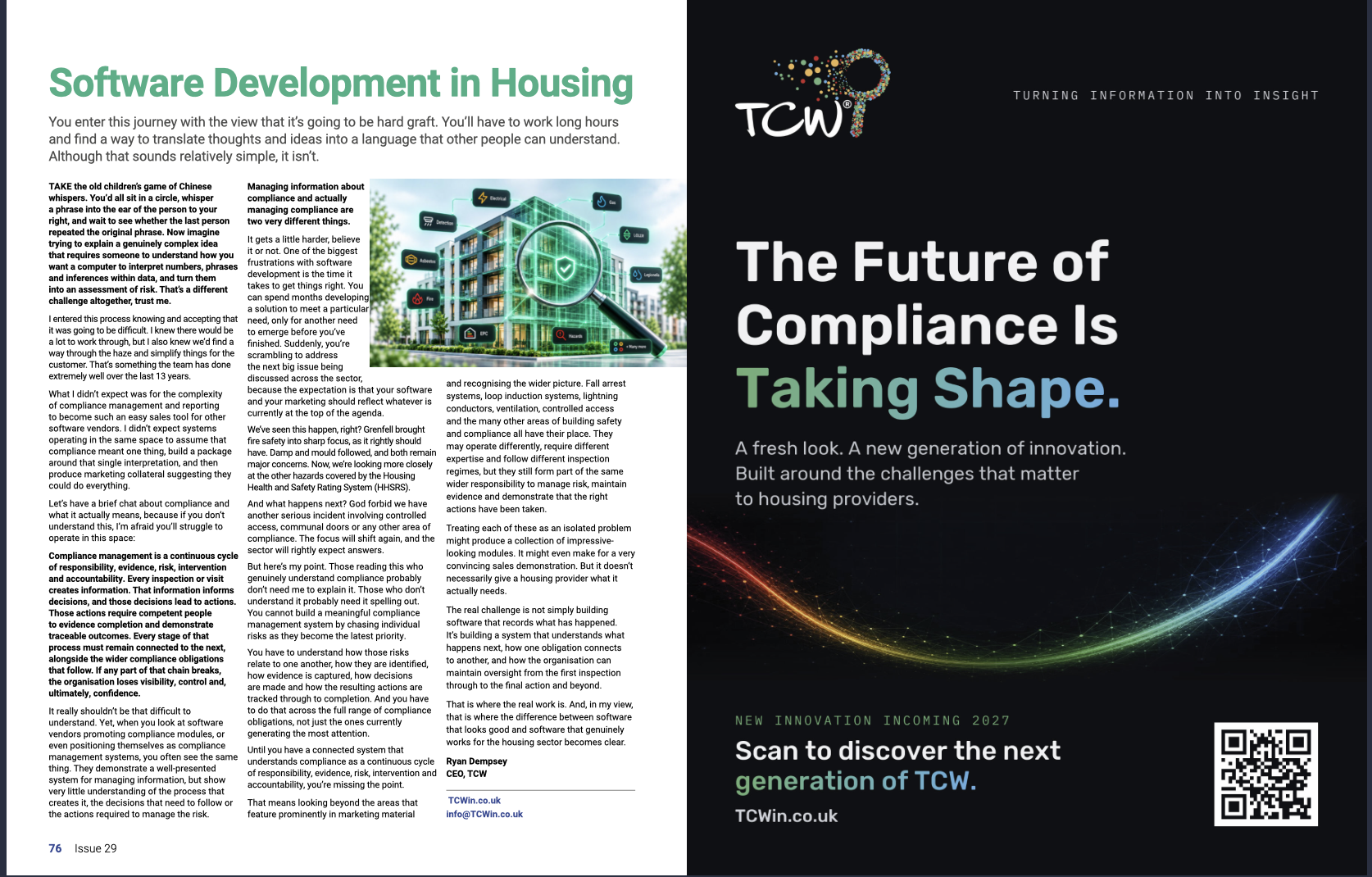
That means looking beyond the areas that feature prominently in marketing material and recognising the wider picture. Fall arrest systems, loop induction systems, lightning conductors, ventilation, controlled access and the many other areas of building safety and compliance all have their place. They may operate differently, require different expertise and follow different inspection regimes, but they still form part of the same wider responsibility to manage risk, maintain evidence and demonstrate that the right actions have been taken.
Where the Real Work Is
Treating each of these as an isolated problem might produce a collection of impressive-looking modules. It might even make for a very convincing sales demonstration. But it doesn’t necessarily give a housing provider what it actually needs.
The real challenge is not simply building software that records what has happened. It’s building a system that understands what happens next, how one obligation connects to another, and how the organisation can maintain oversight from the first inspection through to the final action and beyond.
That is where the real work is. And, in my view, that is where the difference between software that looks good and software that genuinely works for the housing sector becomes clear.
Ryan Dempsey CEO, TCW
Questions this Article Answers
Questions This Article Answers.
Use This Insight
Use This Insight.
If you are reviewing your current systems, ask:
- Do our systems connect inspections, decisions and actions through to completion?
- Are we managing compliance, or only managing information about compliance?
- Do we cover every compliance obligation, not just the ones currently in the headlines?