In print
Collaboration in Housing Technology
What do Post-it Notes and Viagra have in common? Both came about through accidental collaboration between teams that didn't set out to produce them. The same principle drives success in housing technology.
18 NOVEMBER 2025 · 5 MIN READ · 5 min read
In Print
As Featured in Housing Executive.
Issue 23 · November / December 2025 · Page 98
The argument
Breakthroughs Through Accidental Collaboration
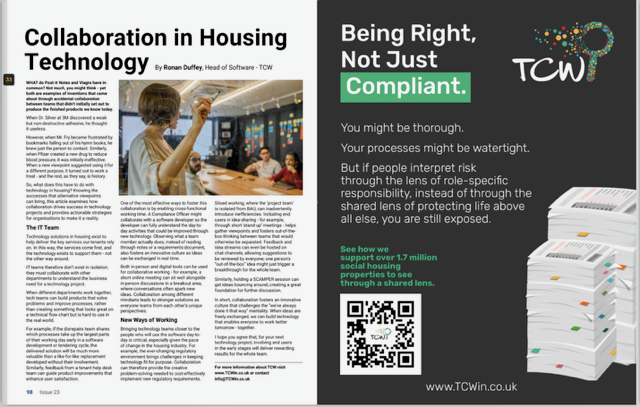
What do Post-it Notes and Viagra have in common? Not much, you might think, yet both are examples of inventions that came about through accidental collaboration between teams that didn't initially set out to produce the finished products we know today.
When Dr. Silver at 3M discovered a weak but non-destructive adhesive, he thought it useless. However, when Mr. Fry became frustrated by bookmarks falling out of his hymn books, he knew just the person to contact. Similarly, when Pfizer created a new drug to reduce blood pressure, it was initially ineffective. When a new viewpoint suggested using it for a different purpose, it turned out to work a treat, and the rest, as they say, is history.
So, what does this have to do with technology in housing? Knowing the successes that alternative viewpoints can bring, this article examines how collaboration drives success in technology projects and provides actionable strategies for organisations to make it a reality.
The IT Team
Technology solutions in housing exist to help deliver the key services our tenants rely on. In this way, the services come first, and the technology exists to support them, not the other way around.
IT teams therefore don't exist in isolation; they must collaborate with other departments to understand the business need for a technology project. When different departments work together, tech teams can build products that solve problems and improve processes, rather than creating something that looks great on a technical flow chart but is hard to use in the real world.
For example, if the disrepairs team shares which processes take up the largest parts of their working day early in a software development or tendering cycle, the delivered solution will be much more valuable than a like-for-like replacement developed without their involvement. Similarly, feedback from a tenant help desk team can guide product improvements that enhance user satisfaction.
Cross-Functional Working
One of the most effective ways to foster this collaboration is by enabling cross-functional working time. A Compliance Officer might collaborate with a software developer so the developer can fully understand the day-to-day activities that could be improved through new technology. Observing what a team member actually does, instead of reading through notes or a requirements document, also fosters an innovative culture as ideas can be exchanged in real time.
Both in-person and digital tools can be used for collaborative working. For example, a short online meeting can sit well alongside in-person discussions in a breakout area, where conversations often spark new ideas. Collaboration among different mindsets leads to stronger solutions as everyone learns from each other's unique perspectives.
New Ways of Working
Bringing technology teams closer to the people who will use the software day-to-day is critical, especially given the pace of change in the housing industry. The ever-changing regulatory environment brings challenges in keeping technology fit for purpose. Collaboration can therefore provide the creative problem-solving needed to cost-effectively implement new regulatory requirements.
Siloed working, where the 'project team' is isolated from BAU, can inadvertently introduce inefficiencies. Including end users in idea-sharing, for example through short 'stand-up' meetings, helps gather viewpoints and fosters out-of-the-box thinking between teams that would otherwise be separated. Feedback and idea streams can even be hosted on chat channels, allowing suggestions to be reviewed by everyone; one person's 'out-of-the-box' idea might just trigger a breakthrough for the whole team. Similarly, holding a SCAMPER session can get ideas bouncing around, creating a great foundation for further discussion.
In short, collaboration fosters an innovative culture that challenges the 'we've always done it that way' mentality. When ideas are freely exchanged, we can build technology that enables everyone to work better tomorrow, together. I hope you agree that, for your next technology project, involving end users in the early stages will deliver rewarding results for the whole team.
"The services come first, and the technology exists to support them, not the other way around."
Questions this Article Answers
Questions This Article Answers.
Use This Insight
Use This Insight.
If you are reviewing your current systems, ask:
- Have end users from each affected team been involved from the start of the project?
- Do developers spend time observing the day-to-day work the software will support?
- Is the project team connected to BAU teams, or working in a silo?
- Is there a shared channel where anyone can submit feedback and ideas?
- Are you challenging the 'we've always done it that way' mentality?