
In print
The Crucial Role of Accountability in Safety Management
Clear accountability protects residents. When responsibility becomes confused across departments, safety can become a bargaining chip rather than a non-negotiable priority.
31 July 2024 · 3 min read
Read Housing Executive Issue 14In Print
As Featured in Housing Executive.
Issue 14 · May / June 2024 · Page 70
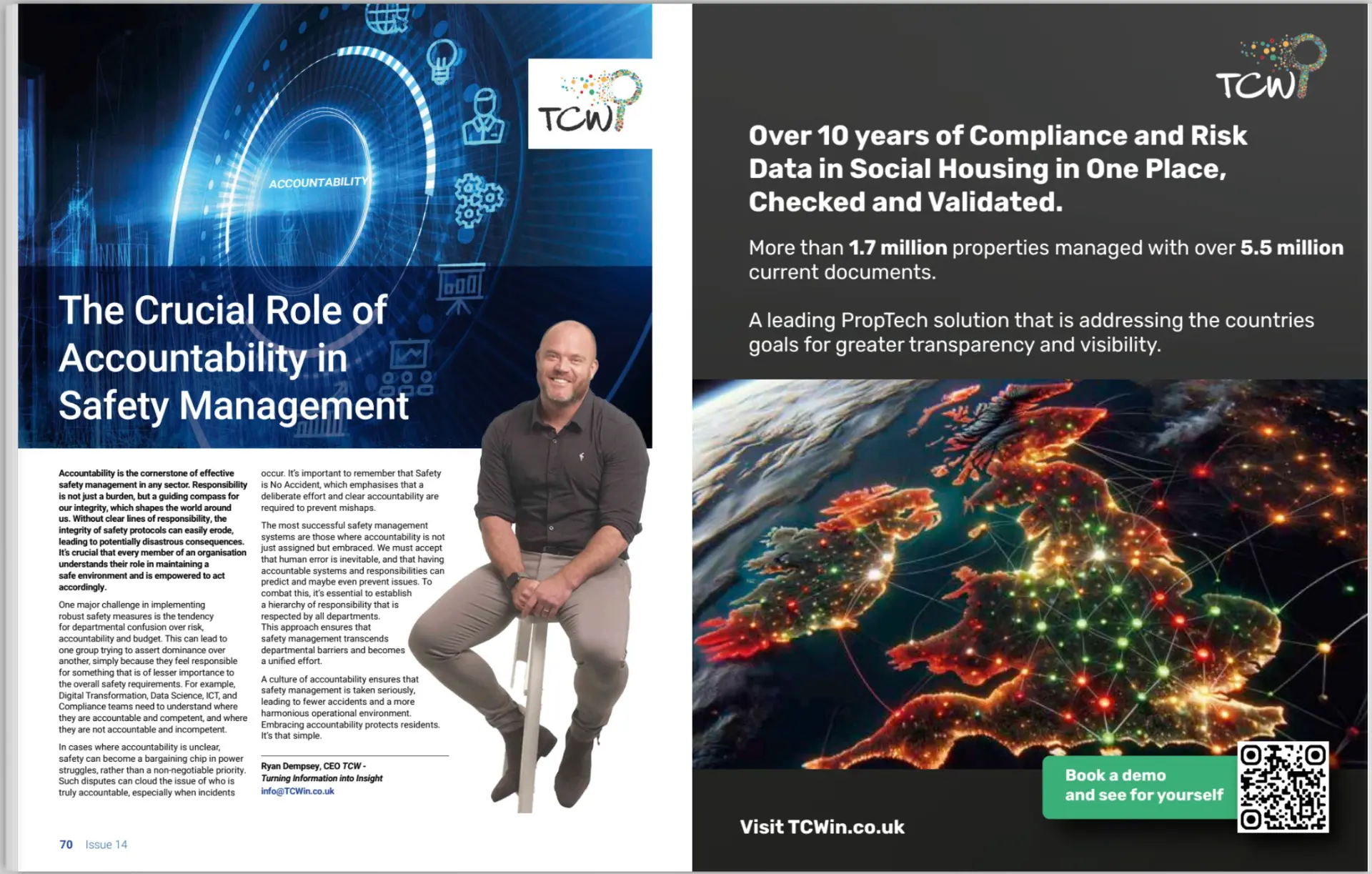

The argument
The Crucial Role of Accountability in Safety Management
Accountability is the cornerstone of effective safety management in any sector. Responsibility is not just a burden, but a guiding compass for our integrity, which shapes the world around us. Without clear lines of responsibility, the integrity of safety protocols can easily erode, leading to potentially disastrous consequences. It’s crucial that every member of an organisation understands their role in maintaining a safe environment and is empowered to act accordingly.
One major challenge in implementing robust safety measures is the tendency for departmental confusion over risk, accountability and budget. This can lead to one group trying to assert dominance over another, simply because they feel responsible for something that is of lesser importance to the overall safety requirements. For example, Digital Transformation, Data Science, ICT, and Compliance teams need to understand where they are accountable and competent, and where they are not accountable and incompetent.
In cases where accountability is unclear, safety can become a bargaining chip in power struggles, rather than a non-negotiable priority. Such disputes can cloud the issue of who is truly accountable, especially when incidents occur. It’s important to remember that Safety Is No Accident, which emphasises that a deliberate effort and clear accountability are required to prevent mishaps.
The most successful safety management systems are those where accountability is not just assigned but embraced. We must accept that human error is inevitable, and that having accountable systems and responsibilities can predict and maybe even prevent issues. To combat this, it’s essential to establish a hierarchy of responsibility that is respected by all departments. This approach ensures that safety management transcends departmental barriers and becomes a unified effort.
A culture of accountability ensures that safety management is taken seriously, leading to fewer accidents and a more harmonious operational environment. Embracing accountability protects residents. It’s that simple.
Questions this Article Answers
Questions This Article Answers.
Use This Insight
Use This Insight.
If you are reviewing your current systems, ask:
- Can every team clearly explain which safety risks it owns and where its competence ends?
- Are accountability and budget decisions aligned, or do they create gaps and departmental conflict?
- Is there a respected hierarchy for resolving responsibility when risks cross departmental boundaries?
- Do our systems make ownership visible before an incident occurs—not only afterwards?