In print
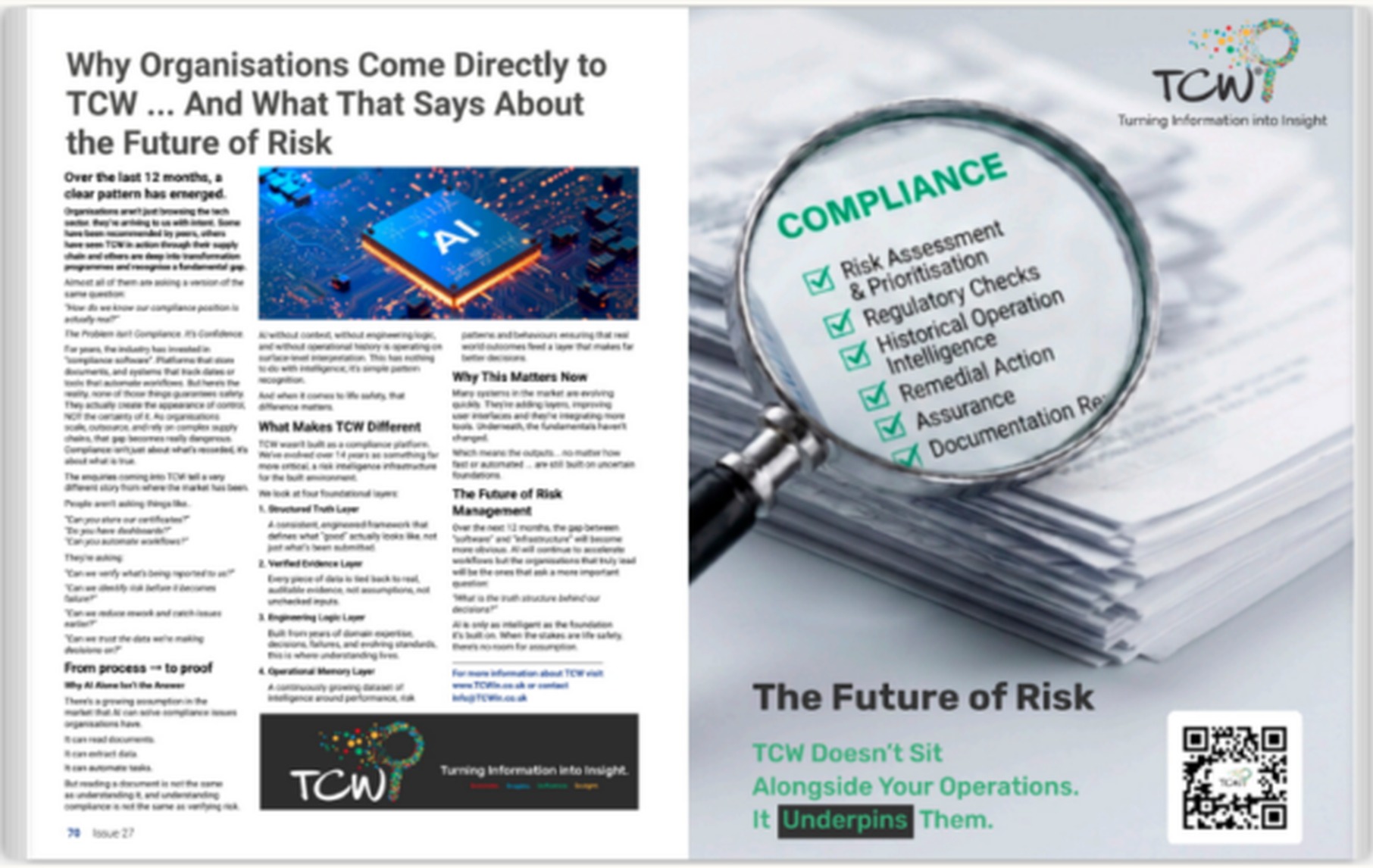
Why Organisations Come Directly to TCW, and What That Says About the Future of Risk
Over the last twelve months a clear pattern has emerged. Organisations are not browsing the technology market. They are arriving with intent, and asking a harder question.
21 July 2026 · 6 min read
In Print
As Featured in Housing Executive.
ISSUE 27 · JULY 2026 · PAGE 70 ·

The argument
A Clear Pattern Has Emerged
Organisations are not just browsing the technology sector. They are arriving at TCW with intent. Some have been recommended by peers, others have seen TCW in action through their supply chain, and others are deep into transformation programmes and have recognised a fundamental gap.
Almost all of them are asking a version of the same question: how do we know our compliance position is actually real?
The Problem Isn't Compliance. It's Confidence.
For years the industry has invested in compliance software: platforms that store documents, and systems that track dates or tools that automate workflows. But none of those things guarantees safety. They create the appearance of control, not the certainty of it.
As organisations scale, outsource and rely on complex supply chains, that gap becomes genuinely dangerous. Compliance is not just about what has been recorded. It is about what is true.
The enquiries coming into TCW tell a very different story from where the market has been. People are no longer asking 'can you store our certificates?', 'do you have dashboards?' or 'can you automate workflows?'. They are asking: can we verify what is being reported to us? Can we identify risk before it becomes failure? Can we reduce rework and catch issues earlier? Can we trust the data we are making decisions on?
From Process to Proof: Why AI Alone Isn't the Answer
There is a growing assumption in the market that AI can solve the compliance problems organisations have. It can read documents. It can extract data. It can automate tasks.
But reading a document is not the same as understanding it, and understanding compliance is not the same as verifying risk. AI without context, without engineering logic and without operational history is operating on surface-level interpretation. That is not intelligence, it is pattern recognition. When it comes to life safety, that difference matters.
What Makes TCW Different
TCW was not built as a compliance platform. It has evolved over more than thirteen years into something far more critical: a risk intelligence infrastructure for the built environment. It rests on four foundational layers.
Structured Truth Layer. A consistent, engineered framework that defines what good actually looks like, not just what has been submitted.
Verified Evidence Layer. Every piece of data is tied back to real, auditable evidence, not assumptions and not unchecked inputs.
Engineering Logic Layer. Built from years of domain expertise, decisions, failures and evolving standards. This is where understanding lives.
Operational Memory Layer. A continuously growing dataset of intelligence around performance, risk patterns and behaviours, ensuring that real-world outcomes feed a layer that makes for better decisions.
Why This Matters Now
Many systems in the market are evolving quickly. They are adding layers, improving user interfaces and integrating more tools. Underneath, the fundamentals have not changed.
Which means the outputs, no matter how fast or automated, are still built on uncertain foundations.
The Future of Risk Management
Over the next twelve months the gap between software and infrastructure will become more obvious. AI will continue to accelerate workflows, but the organisations that truly lead will be the ones that ask a more important question: what is the truth structure behind our decisions?
AI is only as intelligent as the foundation it is built on. When the stakes are life safety, there is no room for assumption.
"TCW doesn't sit alongside your operations. It underpins them."
Questions this Article Answers
Questions This Article Answers.
Use This Insight
Use This Insight.
If you are reviewing your current systems, ask:
- Can we verify what is being reported to us, rather than trust it?
- Can we identify risk before it becomes failure?
- Does our data tie back to auditable evidence, not assumptions?
- What is the truth structure behind our compliance decisions?